EN
EN Français
PRIMAT
PRImordial MATter — Big-Bang Nucleosynthesis abundance computations
General description
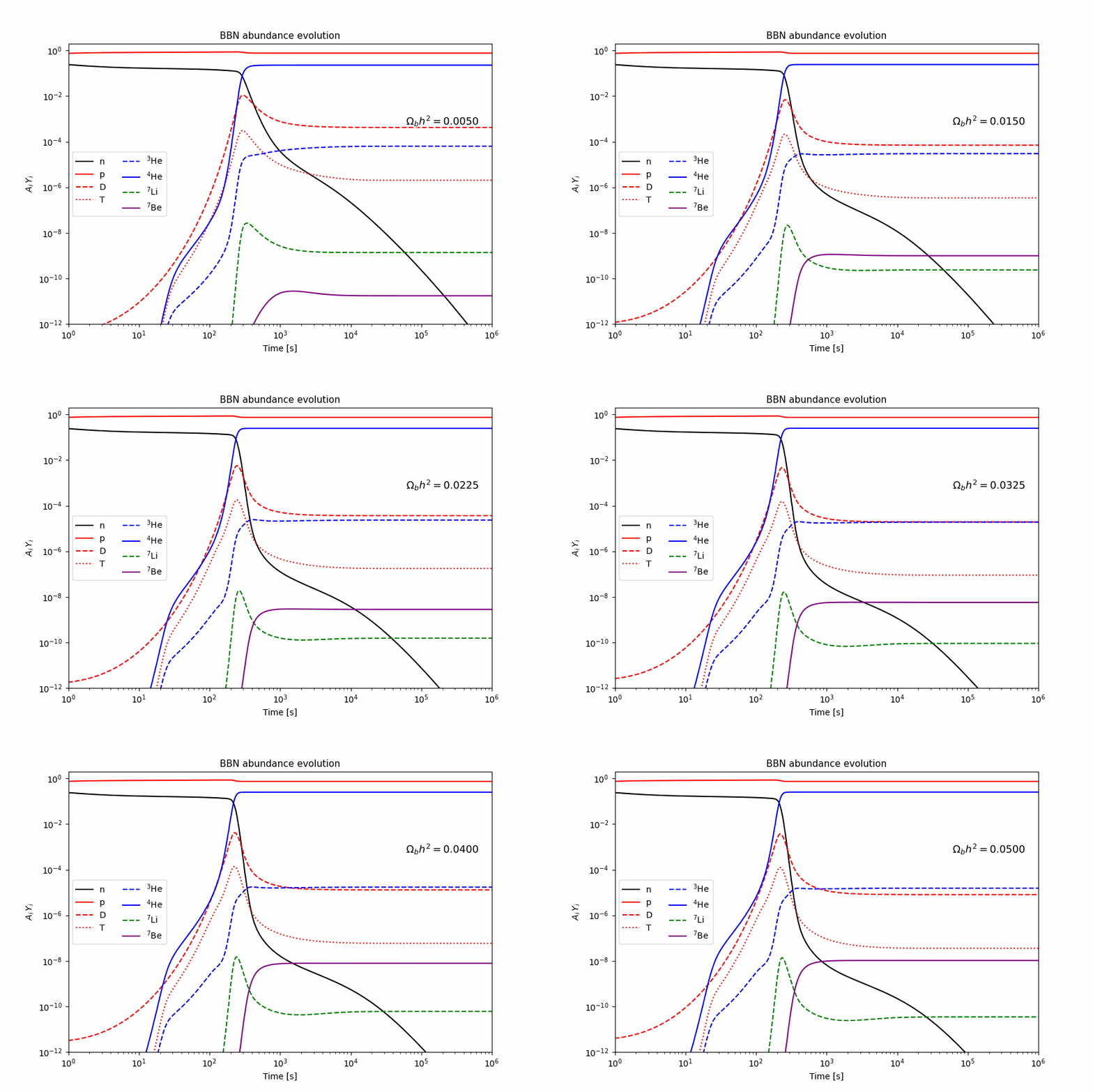
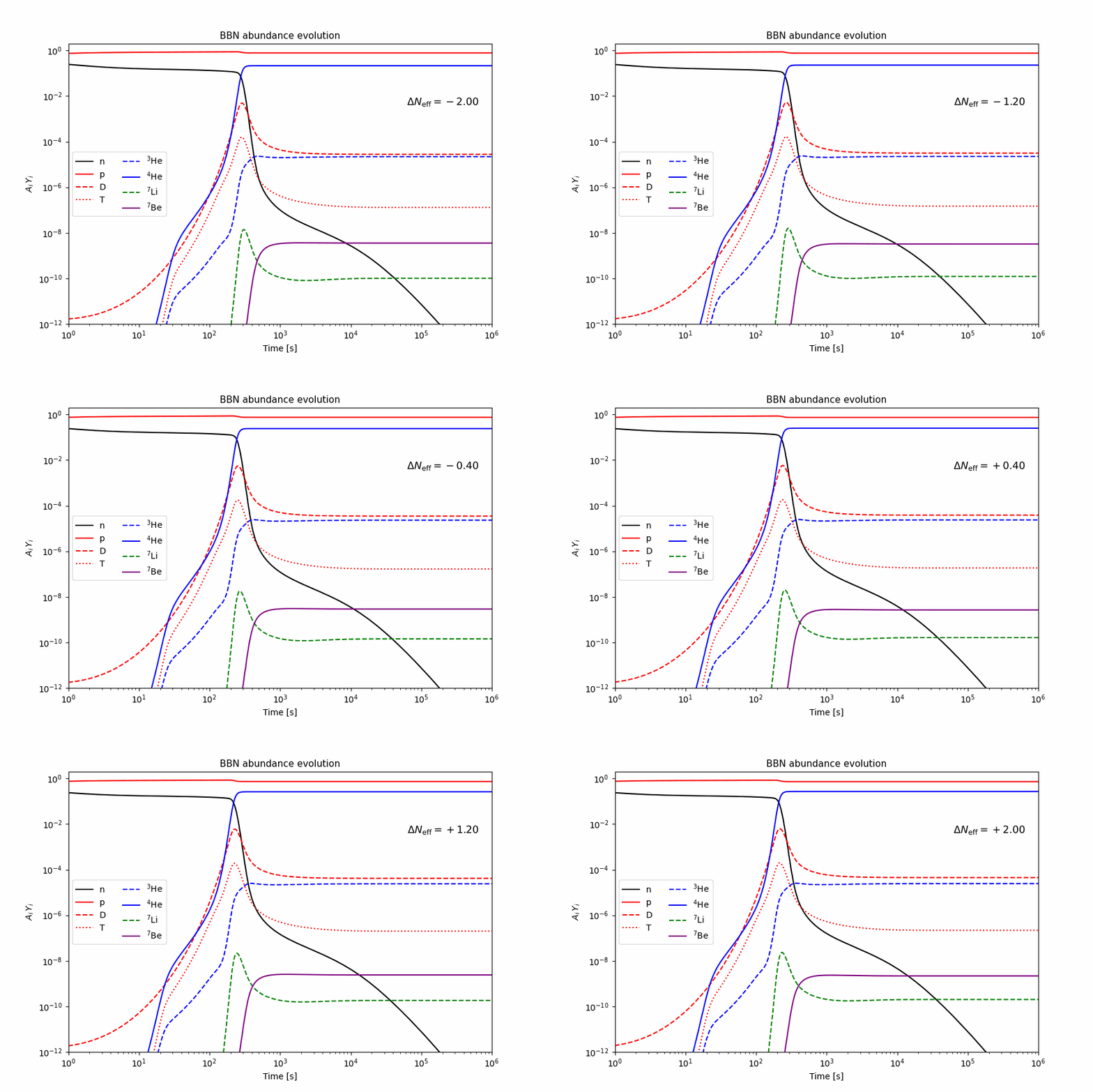
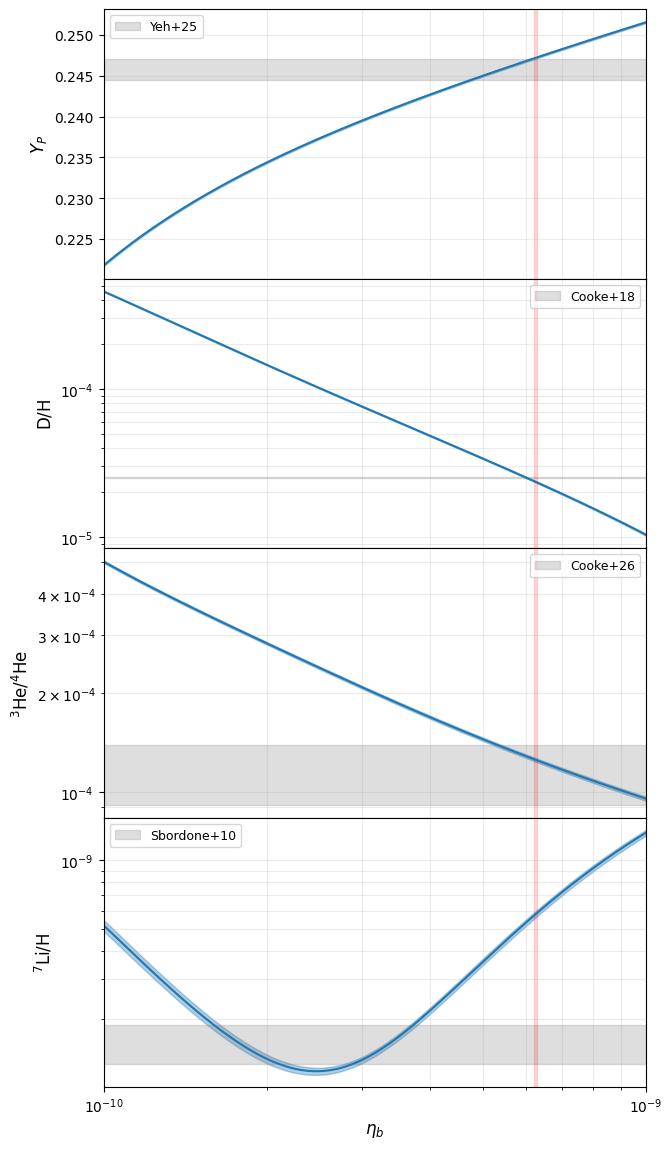
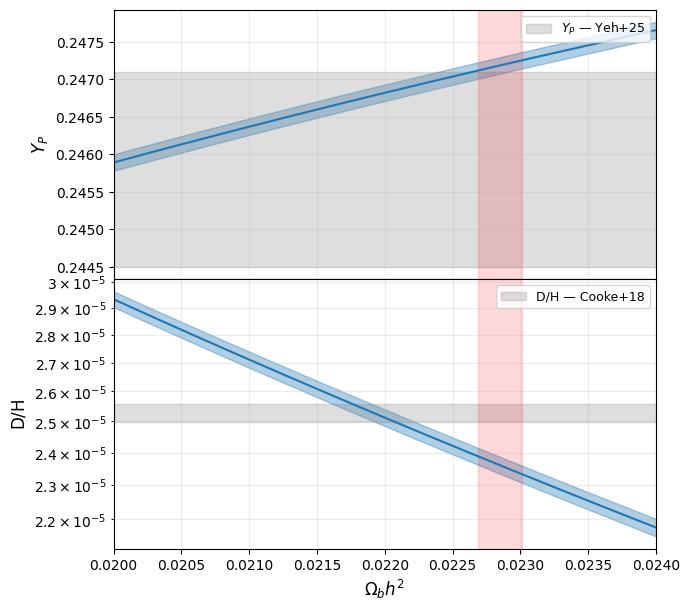
PRIMAT is a code dedicated to the computation of light element abundances at the end of Big-Bang Nucleosynthesis (BBN). It computes the evolution of these abundances in the first minutes after the Big-Bang so as to obtain the frozen values when the temperature dropped below 108 degrees. It allows exploration of the dependence of light element abundances on cosmological parameters such as baryon density or number of neutrino species, and estimation of the uncertainty in these predictions due to uncertainties in nuclear reaction rates. PRIMAT used to be available as a Mathematica package, and now it is a Python/C package.
Documentation
The details of the method used to solve numerically for the thermodynamics, cosmology and nuclear reactions in the early universe are available in a Physics Reports article (04, (2018) 005 [arXiv:1801.08023]). Please cite it along with this website if you use PRIMAT in BBN-related publications, using this bibtex file. See also updates on rates described in MNRAS 502 (2021) 2474–2481 [arXiv:2011.11320].
Discover primat
The easiest way to get started: a free, browser-based interface to primat lets you set cosmological parameters (baryon density, ΔNeff, nuclear network size, …), run a full BBN computation, and explore the resulting abundance evolution and final light-element abundances — all directly in your browser, with no installation required.
🚀 Launch primat-guiInstallation
primat can be installed as a Python package using pip:
pip install primatOnce installed, execute
primat --helpto see all options available
Sources
The source code and development repository for PRIMAT are hosted on GitHub. You can access the latest code on
🔗 github.com/CyrilPitrou/primatThis method is recommended if you want to modify nuclear rates and customize primat. After cloning or downloading the source code, install in development mode with
pip install -e .primat_tools
primat integrates seamlessly with Cobaya, the cosmological Bayesian analysis framework. The companion package primat_tools provides ready-to-use theory and likelihood classes that plug primat into Cobaya pipelines, enabling full Markov Chain Monte Carlo (MCMC) parameter inference with BBN constraints.
🔗 github.com/CyrilPitrou/primat_toolsMathematica version
The (legacy) Mathematica version of PRIMAT is still available on GitHub or as a direct download:
- PRIMAT 0.3.0 (2024, latest)
Examples are provided in the package: basic notebooks show how to get final abundances and draw plots, while more advanced ones run computations on a parameter grid or perform MCMC uncertainty estimation. Pre-computed results can also be downloaded as the Results folder to skip the long runs.
Results
A table of main abundances (He-4 and Deuterium) as a function of baryon abundance and effective number of neutrinos, generated with PRIMAT, is available as a direct download: PRIMAT_Yp_DH_ErrorMC_1000_2026.dat.
You can also consult the list of articles which acknowledge the use of PRIMAT.
License
The programs on this page are distributed as free software under the GNU General Public License. They are distributed in the hope that they will be useful, but WITHOUT ANY WARRANTY; without even the implied warranty of MERCHANTABILITY or FITNESS FOR A PARTICULAR PURPOSE. See the GNU GPL for more details.
Gallery